Literacy Milestones by Age

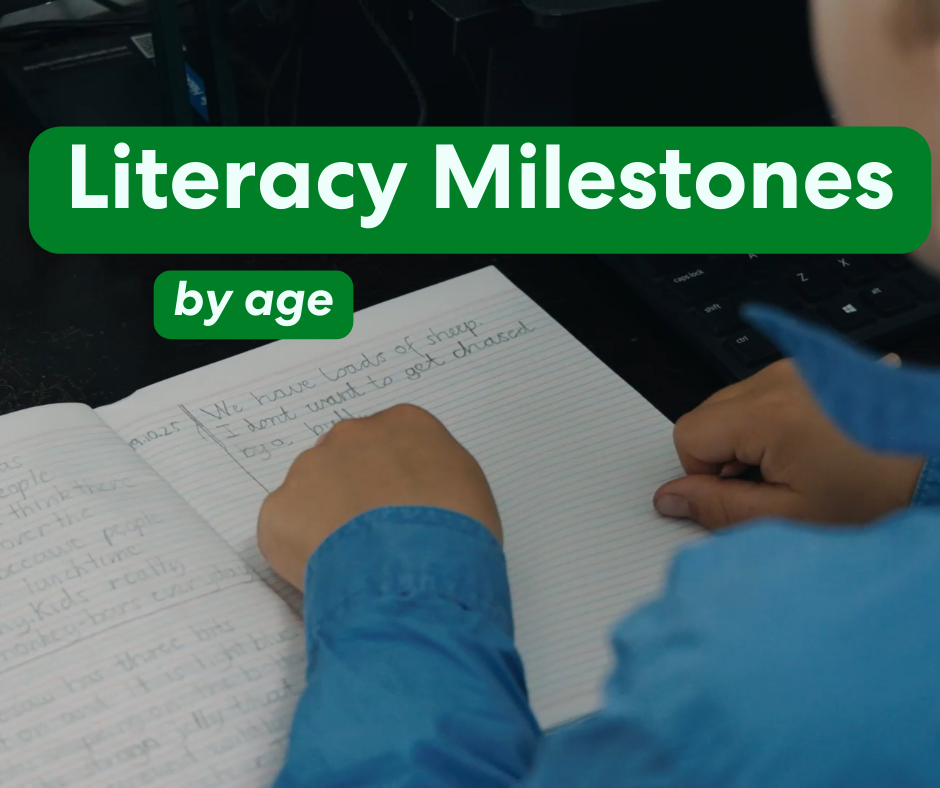
Over the shoulder of a bush kid pointing to words written in a book with the words over the image saying "Literacy Milestones by Age"

Literacy milestones are often talked about as a checklist – letters by this age, reading by that age, spelling by another. In reality, literacy development in children is far more nuanced, individual, and wonderfully diverse. Every child builds literacy skills along their own pathway, shaped by their language experiences, learning environment, and neurotype.

Understanding typical literacy milestones can help parents, carers, and educators recognise when a child might benefit from extra support. That’s where speech therapy can play a powerful, confidence-building role.

All children develop at different rates, the milestones and ages below should be seen as a guide, with each child being nurtured and celebrated for their own unique achievements at every stage.

Literacy Milestones by Age

Literacy Milestones Ages 0-3

  • Speech and language develop from babbles and coos to short phrases. 
  • Looks and listens to stories read aloud. Short books with rhyme, repetition and lots of bright simple pictures are great at this age.
  • Grasps chalks or crayons and progresses from large circles to scribbles. 

Literacy Milestones Ages 3-5

  • Develops a larger vocabulary and clear speech sounds, develops use of more complex spoken sentences.
  • Looks through books independently, turning pages and reciting familiar stories. Begins to understand that letters correspond to sounds. May learn some letter names and/or the sounds they make – “S is for sssssssnake”.
  • Develops early phonological awareness skills – understands that words can rhyme, that words are made up of sounds.
  • Begins to draw letter-like shapes and write their own name or have a go at writing familiar words.  

Literacy Milestones Ages 5-7

  • Develops reading skills and confidence to read independently but still benefits from and enjoys shared reading experiences.
  • Learns to segment (‘r-a-t’) and blend sounds into words. Knows that changing letters and sounds also changes meaning – “rat” vs “bat”.
  • Develops handwriting and spelling skills to write words and sentences with increasing accuracy.
  • Learns how to spell high-use and spelling-list or familiar words. Learns spelling rules to independently spell new words, with increasing success. 

Literacy Milestones Age 7+

  • Uses reading skills to learn, sounds-out longer words independently when reading. Interprets texts for meaning. 
  • Spells multi-syllabic words with increasing success. 
  • Uses writing and spelling skills to create texts that express their ideas in different ways, using more complex sentences and develops use of paragraphs. 

Can Speech Therapy Help Children with Literacy?

Absolutely. Speech therapy can be a key support for children who experience literacy difficulty – whether that shows up as trouble learning letter sounds, reading, spelling, or understanding written language.

What is literacy?

Literacy goes beyond reading and writing. It includes:

  • Understanding spoken language
  • Recognising sounds in words (phonological awareness)
  • Connecting sounds to letters
  • Reading for meaning
  • Expressing ideas through writing

What is a speech therapist’s role in literacy?

Speech pathologists (also called speech therapists) are university-trained professionals who support communication across the lifespan. In relation to literacy development milestones, they work on the building blocks of literacy – such as oral language, vocabulary, listening, phonological awareness, and narrative skills – all of which strongly influence reading and writing success.

At Pop Online Speech Therapy, we support children with literacy difficulties to reach meaningful quality-of-life goals, including:

  • Participating confidently in the classroom
  • Enjoying books and learning
  • Expressing ideas clearly in speech and writing
  • Feeling capable, included, and understood

If you’re wondering whether speech therapy could support your child’s literacy journey, you can book a free 15-minute discovery call with an experienced speech therapist.

Causes and Challenges

Literacy difficulties don’t come from lack of effort or motivation. They can be linked to a range of factors, including:

  • Speech sound differences
  • Developmental language disorder
  • Difficulties with phonological awareness
  • Attention or working memory differences
  • Autism or other neurodivergent profiles
  • Limited access to early literacy experiences

When children don’t receive appropriate support, literacy challenges can affect:

  • Academic progress across all subjects
  • Confidence and self-esteem
  • Participation in classroom activities
  • Emotional wellbeing and peer relationships

Families may also notice stress around homework, avoidance of reading, or growing frustration – all signs that support could be helpful.

Understanding Literacy

Speech pathologists don’t “label” children - they understand them.

Can speech pathologists diagnose literacy difficulties?

Speech pathologists can assess and identify literacy difficulties and related language challenges. A formal diagnosis of a specific learning disorder (such as dyslexia) may involve an Educational Psychologist, but speech pathologists at Pop can assist in the assessment and intervention journey.

What signs of literacy difficulty do speech pathologists look for?

  • Difficulty recognising or producing rhyming words
  • Trouble breaking words into sounds
  • Challenges learning letter-sound relationships
  • Avoidance of reading or writing tasks
  • Difficulty following written instructions

Real-life examples of literacy difficulties you might notice as a parent:

  • Your child enjoys stories but struggles to decode words
  • Reading feels effortful and tiring
  • Written work is much shorter than spoken ideas
  • Spelling is inconsistent and unpredictable

These signs can appear despite strong intelligence and creativity – literacy difficulty is not a reflection of a child’s potential.

The Role of Speech Therapy in Supporting Literacy Skills

Speech therapy for kids focuses on strengthening the foundations that literacy is built on. Common interventions include:

1. Phonological awareness therapy

Helping children hear, identify, and manipulate sounds in words.

Listen to more about why phonics are important on our podcast episode here.

2. Oral language and vocabulary development

Building understanding and use of words to support reading comprehension and writing.

3. Sound–letter knowledge and decoding strategies

Supporting children to connect spoken sounds with written symbols.

Tips for parents and how families can help at home:

  • Read aloud together daily (even for school-age children)
  • Play sound and word games
  • Celebrate effort, not speed or accuracy
  • Offer choice in reading materials to build motivation

Small, consistent moments matter.

Benefits of Intervention in Literacy

Speech therapy for literacy can support children in many meaningful ways:

📖 Improved reading accuracy and fluency

✍️ Stronger spelling and writing skills

✨ Increased confidence and self-esteem

✋ Better classroom participation

😌 Reduced frustration and avoidance

💬 Stronger oral language skills

🎓 Improved academic outcomes across subjects

❤️ Enhanced social connection and wellbeing

When literacy becomes more accessible, children often feel more capable – and that confidence carries into friendships, learning, and everyday life.

Recognising the Signs: When to Seek Speech Therapy for Literacy Difficulties

When do literacy difficulties usually appear?

Early literacy milestones begin well before school, often between ages 3–5. Difficulties may become more noticeable in the early years of schooling, particularly when formal reading and writing instruction begins.

Common signs it’s worth seeking support:

  • Difficulty learning letter names and sounds
  • Trouble blending sounds to read words
  • Avoiding books or written tasks
  • Slow or laboured reading
  • Ongoing spelling difficulties
  • Strong verbal skills but weak written expression

Further Support to Identify Literacy Difficulties in Kids

Listen to the Beyond Words by Pop Family Podcast

If you’re recognising these signs in yourself or a loved one, you don’t have to figure it out alone.

Book a free 15-minute discovery call with Pop Online Speech Therapy to talk through next steps:

How Long Does Speech Therapy for Literacy Take?

There’s no one-size-fits-all answer. Some children begin noticing changes within a few sessions, while others benefit from longer-term support. Progress might look like:

  • Increased confidence with reading
  • Improved accuracy or comprehension
  • Reduced stress around literacy tasks
  • Greater willingness to engage

Speech therapy is about sustainable growth – not rushing milestones.

Start Your Speech Therapy Journey with Pop Online Speech Therapy Today!

Literacy milestones are guides, not deadlines.
Every child’s literacy journey is unique and valid.
Support can make that journey feel lighter and more empowering.

If you’re curious whether speech therapy could help, book a free 15-minute discovery call with Pop Online Speech Therapy to explore the best next step for your family.

Author

Picture of Pop

Pop

Share This Post

More To Explore

Begin your journey with Pop

In this discovery call, the Speech Therapist will:

P.S. If you have had speech therapy before or already know what you’re after, you can jump to our appointment booking form here.

Book your free 15 minute discovery call with one of our experienced Speech Therapists below.

Book a Free Discovery Call

Online Speech Therapy, all sessions delivered via telehealth.

Fill out the form below and we’ll be in touch.

100% Telehealth, For Every Age & Stage - Trusted by 4,000+ Australians